Monthly Battery
ℹ️ Available for Nano-Grid and Illumient. Coming soon for Esite-Micro, Pico-Grid and Senti
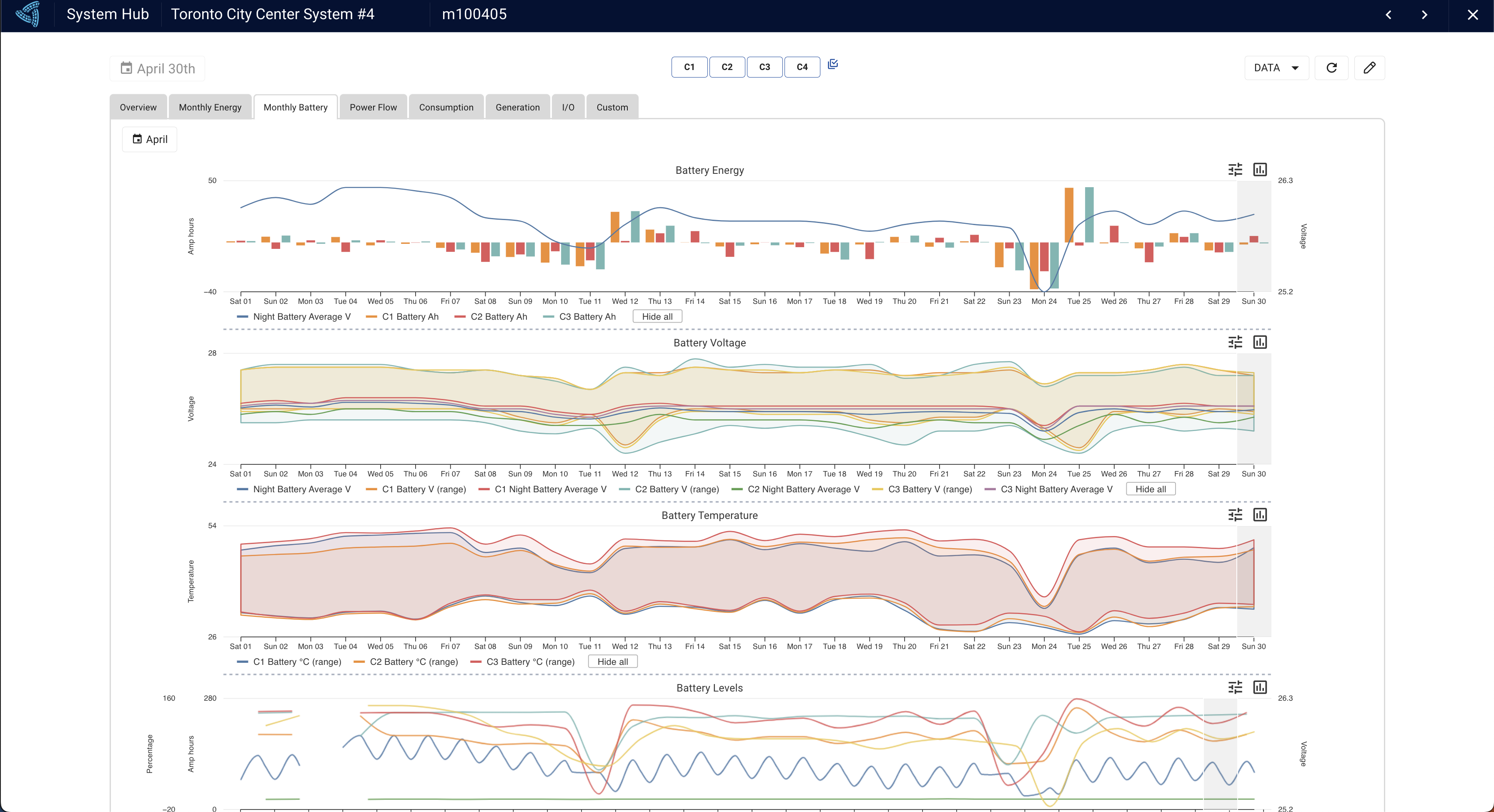
The Monthly Battery Hub offers valuable insights into battery trends, including information on energy consumption, voltage levels, temperature fluctuations, and charge status. By tracking these metrics, you can gain a better understanding of your batteries' overall performance and make informed decisions about their usage. With access to this data, you can optimize your battery system and ensure that it operates at peak efficiency.
Battery Energy
Battery energy is a measure of the total Ampere-hours (Ah) or Watt-hours (Wh) (can be change through  ) that a battery has either consumed or generated over the course of a day. This information can be extremely helpful in determining which batteries are consuming or generating the most energy in the system.
Battery Level
ℹ️ Battery level is currently a beta feature.
Battery level is the percentage of energy left in the battery. Throughout a day you will see a battery level for sunrise, sunset and midnight. This data is updated every midnight. Battery level can be useful to understand the overall amount of energy discharged and charged on a daily basis, which can help monitor and maintain the health of the system's batteries.
Charge Percentage
Charge percentage is a measure of the energy input compared to the energy consumed in the system. Typically, a daily charge percentage of around 100-105% is expected due to inefficiencies in the system. A charge percentage higher than this suggests undercharging of the battery, while a lower percentage indicates insufficient charging.
Midnight Load Discharge Percentage
Midnight load discharge percentage is a measure of its rate of discharge relative to its maximum capacity. It is calculated by dividing the amount of energy (Ah) discharged between sunset and midnight by the battery's capacity (in amp-hours). It helps indicate how heavy the batteries are being discharged.
Charge Phase
Batteries are charged through four phases: 1, 1.5, 2 and 3. They mean the following:
| Charge Phase | Description |
|---|---|
| 1 | This phase is also known as the bulk phase. During this phase the batteries are charged up to the maximum safe rate of charge by letting all the current from the energy source through to the batteries. It occurs when the voltage of the system has not yet reached the Phase 2 voltage limit set by Clear Blue. |
| 1.5 | This phase, also known as bulk phase extension, is reached once the voltage of the system reaches the Phase 2 voltage limit. Clear Blue’s patented charging algorithm trickle charges the batteries to ensure that the capacity of the batteries is truly at ~80% before moving on to the next phase. |
| 2 | This phase is known as the absorption phase. It holds a certain voltage until the remaining ~20% of the battery is filled. |
| 3 | This phase is known as the float phase. It allows the battery voltage to drop and is then held constant. Simultaneously, the current is reduced to <1% of the battery capacity. Once this phase is reached the system is considered fully charged. |
Clear Blue can modify the charge phase settings so that your batteries can be charged as optimally as possible.
The colours are indicating the max charge phase reached that day. Ideally each system should be showing green at least every few days for good battery health.
Overvoltage
On the Battery Energy chart, there is a possibility of encountering overvoltage. Overvoltage happens when the battery voltage exceeds a certain threshold. The count displayed on the chart indicates the number of instances (at a 1/4s rate) where the battery voltage exceeded the specified value.
ℹ️ For more information on overvoltage and the thresholds, contact the Clear Blue service team.